Showing posts with label ERF. Show all posts

Saturday, 1 February 2014

2wayFix & 2wayPearl in Vauxhall Insignia

J often goes out in the car with his grandparents (my parents). Up til now they have been using the Maxi Cosi FamilyFix base. Initially this was in combination with his CabrioFix carseat or their Pebble, and then in combination with their Pearl carseat. We are currently using the new Maxi Cosi 2wayFix base in combination with the 2wayPearl. This combination can be used from six months to fifteen months rear facing. From fifteen months you can forward face the carseat until 105cm (approx. 4 yrs old) or you can continue using the seat rearfacing until 105cm. Under new iSize legislation the requirement is mandatory that the child is rearfacing until 15 months – Maxi Cosi recommend til at least two years. My point of view is that if it can be used rearfacing til 105cm, and we know this is the safest option for travel for children, why not use it?


Grumpa has a Vauxhall Insignia. This is a long, large size family car. The 2wayFix base fits well into the rear seat without any adjustment required for the front seat passenger. The 2wayFix base is longer from front to back of the seat than the FamilyFix base but in this vehicle that does not make a difference. There is no under floor storage in this vehicle, but remember to remove the floor mats and have the front support leg directly against the floor of the vehicle. The 2wayPearl fitted rear facing on the base nicely and there was a good hand gap between the back of the carseat and the back of the vehicle passenger seat in front, even when the 2wayPearl was reclined. The 2wayFix base and 2wayPearl combination is very easy to fit and provides audible noises and green / red light indicators to show correct fitting.  Grumpa likes this feature of the product as it gives him confidence that he has fitted it properly.

L-R: Vauxhall Insignia / J rearfacing in 2wayPearl / Grumpa demonstrates front passenger leg room


When it came to putting J into the carseat we encountered some difficulty. J is on the top end of the scale for using this product, he is 3.5yrs old, 101cm and 15.5kg. The difficulty encountered was not because of the carseat – it was due to the steep slope of the roof of the Insignia, which minimised space for being able to get J into the 2wayPearl in rearfacing position. It made it awkward, but not impossible, and he was quickly in the seat and comfortable. He immediately crossed his legs in front of him, as a child of his age will naturally do.

When we were out in the car, he was high enough to see out the rear window, so he was waving at the people in the vehicles behind us and thoroughly enjoyed a night time cruise through town enjoying looking at the Christmas lights out the window. People seem to think that rearfacing is more likely to make the child carsick – if you find your child suffers carsickness, try using sun visors over the side windows so they can only see out the rear window, as this is less likely to confuse the brain. J has enough space in this seat to be comfortable and safe while rearfacing and when he became bored of looking out the rear window he had a magazine to read and then played with his Leappad for a while, both of which fitted on his lap probably better than if he’d been forward facing, as the angle of the seat made it less likely to slip off his lap. He remained well entertained throughout the journey. I am really impressed with this base and carseat combination. 


These views are entirely my own. I am not paid to write this material and do so in my own time.


Extended Rear Facing (ERF) Explained


As ex-ambulance control staff, currently working in the nursery industry and a mum as well, I know too well the importance of carseat safety. I’m carseat fitter trained and take great care each time to ensure that J is secured properly in his carseat. I take the seat out of the car to clean it and re-fit it once a month to ensure it is working as it should be and is correctly installed. One of my pet hates are people ignorant of the dangers of an incorrect carseat fitting in their vehicle, incorrect use of the carseat harness (too loose) or people who are so desperate for their child to go into a forward facing carseat as soon as possible.

Rearfacing is safest. Extended rear facing (known as ERF) has been around for ages, but it’s only in the last few years that it has come to the UK and is becoming more common. Due to the fact a baby and toddler has such a large, heavy head in comparison with the rest of their body, plus the fact their neck and spinal muscles are less developed than an adults, means that in an impact in a rear facing carseat they will be pressed into the seat and the force distributed across their shoulders. In a forward facing carseat, an impact will cause their head to snap forward, putting extreme stress on their neck and spinal muscles, which in some cases can be fatal.

The head of a baby / small child is much larger & heavier than that of an adult


As one of the biggest carseat manufacturers, Maxi Cosi noted the growing public call for ERF seats and became heavily involved with a project for the next stage of carseat safety standard. Currently, all European carseats have to meet ECE R44-04. This is an amended standard of the previous one, and not a lot changed. In reality, to meet this standard, a carseat is not put through its paces particularly well. For instance, there is no rollover test or side impact test before the seat can be awarded this standard. Maxi Cosi, on the other hand, have been exceeding the standard for quite a while by producing carseats which go above and beyond the standard – but of course there is no additional award or standard that can be given, so their carseats wear the same standard ECE badge as a cheap £20 carseat that barely meets standard. As a parent, how are you meant to know which is the best option? Especially in these times of everyone being financially stretched, it’s easy to see why parents do buy cheap carseats – after all, if they all meet the standard, the only difference is the price, right? It may come as a shock to many to learn that this is not the case. In fact, you could compare it to the difference between a supermarket value brand food and the finest range.

Maxi Cosi’s involvement in developing the next stage of carseat safety standard has allowed them to put forward their own ideals for what a carseat should be tested to before it is sold and considered an optimum safety carseat. This standard is called iSize. This new standard changes what criteria the product has to meet. Currently, the Maxi Cosi 2wayFix base when used in combination with the 2wayPearl is the only iSize approved carseat unit.

Under the current standard, your standard Group 1 carseat is suitable from 9-18kg. As a guideline, the age “approx. 9 months – 3.5yrs” is added. Many people don’t see the weight as being the important bit, even though it is the vital information in this statement. They ignore the “approx.” and as soon as their child is nine months old they rush them into a forward facing carseat, whether or not they are the minimum 9kg weight. To discourage this, the new iSize standard states that when using an iSize seat the child remains rearfacing til 15 months, regardless of height or weight. This is because it is not until 15 months that their neck muscles are developed enough to limit damage in an impact. Maxi Cosi recommends when using an iSize seat that the child is rearfacing til 2 years. In a Maxi Cosi 2wayPearl (used in combination with 2wayFix base) the seat can be forward faced at 15 months or you can continue to use it rearfacing until 105cm (approx 4 yrs) 

My son J has always been very tall – as a baby he was very long. He outgrew his CabrioFix carseat at nine months old due to his height, but he was nowhere near 9kg; which is why we then got him an Opal, and he remained rearfacing til he was almost 19 months. I don’t have IsoFix in my car, so it takes some option out of selecting a suitable carseat, but both my parents cars have IsoFix and so our 2wayFix and 2wayPearl product testing is carried out using their vehicles.


Sunday, 12 January 2014

Daily Photo Challenge - 09.01.14

Back to work today after my "weekend" days off. The launch of 2014 Collections has prompted an influx of questions from customers. Where can I buy ... Which retailer will have ... What is RRP ...

Added to that a relatively new concept for the UK of Extended Rear Facing (ERF) and the new iSize standard and you have the recipe for lots of customers asking lots of questions. Thursdays always are my busiest day, but today was even crazier than normal.

I choose this as my photo of today as though it wasn't taken today it is one I used today when explaining how an older / taller child could be comfortable ERF. J's cheeky grin and look of comfort has already received several "Likes" - he's a mini celebrity!

Saturday, 30 November 2013

Maxi-Cosi 2wayFix base and 2wayPearl - An Introduction

As you may have gathered from some of the posts I’ve been doing recently, my most recent product test will be the new Maxi-Cosi 2wayFix base and 2wayPearl carseat.

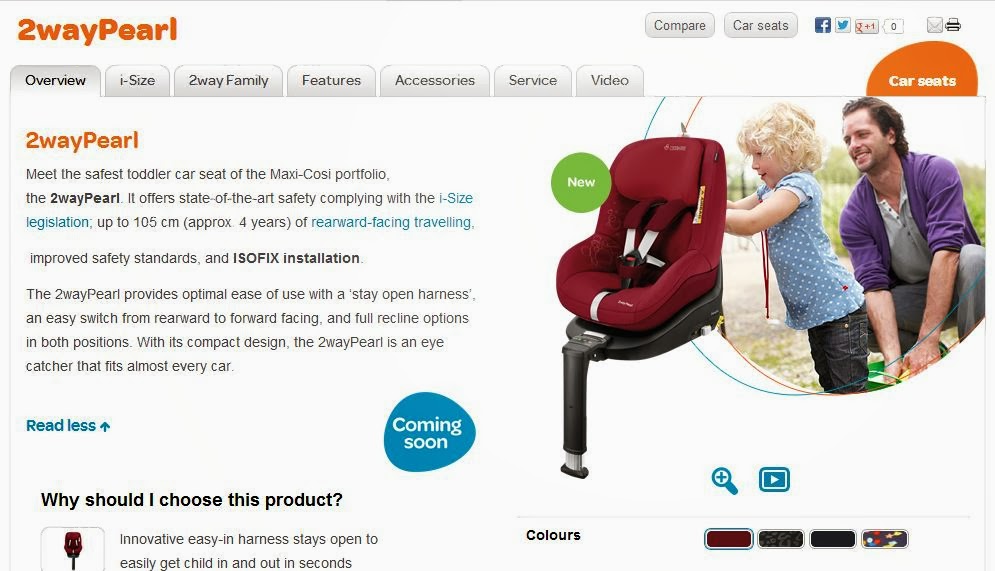
Maxi-Cosi 2wayFix base and 2wayPearl 2014 Raspberry Red rear facing position

Maxi-Cosi 2wayFix base and 2wayPearl 2014 Raspberry Red forward facing position


This brand new product is not yet available for sale. It will be officially launched in January 2014 and can be purchased from your local Maxi-Cosi retailer. However I have been fortunate enough to be selected by Maxi-Cosi since J meets the criteria exactly that they’re looking for to get feedback about this product.

Extended Rear Facing (ERF) is much safer than putting your child travelling forward facing too soon. Currently the European standard is ECE R44-04 which states that a child can go into a forward facing carseat at a minimum of 9kg. To accompany this information, there is an approximate age guideline of 9 months. However, the truth is that many children are not the minimum weight of 9kg when they reach 9 months old – J wasn’t 9kg til he was almost a year old – but many parents misunderstand the information provided and when they see the approximate age guideline they accept that as the age that their child must go into a Group 1 carseat, which most commonly is forward facing. The result is that many children go into a forward facing Group 1 carseat much sooner than necessary. 

Group 0+ carseats (infant carriers) are suitable til 13kg. J didn’t reach 13kg til he was 20 months old. Technically speaking I could have been transporting him in the CabrioFix or Pebble carseat til he reached 20 months old on the basis of his weight – however, due to his height, this wasn’t possible. As a very long baby / now tall child, the harness of his CabrioFix was over a half inch below his shoulders and his head was crowning over the top lip of the CabrioFix by the time he was 9 months old. It was for that reason I swapped him into an Opal carseat, to keep him rear facing for longer as the thought of him going into a forward facing carseat at that point was not an option as far as I was concerned, especially since he was not yet the minimum weight requirement for a Group 1.

When you look at a baby, toddler or pre-school child you will notice their head is rather large and out of proportion in comparison to the rest of them. Couple this with the fact that their neck / spine muscles are less developed than an adults, and in a forward facing carseat a rear impact could cause some serious injuries to a child that is too young. If an impact can give an adult whiplash, think how much damage that could do to a delicate child’s neck? In a rear facing carseat the child will be pushed into the safety of the seat during impact, the shock being absorbed by the seat across the width of their shoulders rather than concentrated on the neck.


Some people will say that their child is too tall to be comfortable rear facing. J was rear facing in his Opal til he was 19 months old and he had plenty of room. At 19 months old he reached the maximum height to be rear facing in the Opal – there is a guide on the side of the carseat to demonstrate when the child is too tall for rear facing and must go forward facing. At no point were his legs squashed, or did he show any signs of being uncomfortable. Far from not liking travelling backwards he always enjoyed it, and being able to play peek-a-boo with other drivers when we were travelling in the car was a favourite past time of his. Even if his legs had been a bit squashed I would far prefer an ankle or leg injury in comparison to a neck or spinal injury had we ever been involved in an accident.

Comfortable and snoozing, rear facing in the Opal carseat at 18 months old


Lots of people will say their child prefers to be forward facing. How does the child know, if they have only ever travelled rear facing, that they prefer forward facing? Why is the child dictating what to do when as the parent, it is your job to keep them as safe as possible? You wouldn’t let them run in the road because they wanted to, because you know it’s not safe – so as you know its safest to travel rear facing for as long as possible, why not? It’s safer for everyone to travel rear facing, adults included – the amount of whiplash injuries caused by RTC’s show that.

J was still rear facing in my car in the Opal long after he was forward facing in my parents cars in the Pearl. He used the Pebble on the FamilyFix base in their cars for longer than he was in the CabrioFix in mine simply for the fact that the recline option for the Pearl on the FamilyFix base provides a more upright sitting position for the Pebble or CabrioFix and allows more leg room. Once he reached 9kg he then started using the Pearl in their cars, but always as reclined as possible, so that in an impact the shock would travel up the length of the carseat rather than against him. Due to this he knew what it was like to be forward facing and rear facing, and I never had any issues getting him to travel rear facing in my car. It was also far easier to get him in a rear facing seat as you place them into the seat from a comfortable position outside the car – in a forward facing seat it’s much more awkward to get them into the seat properly (with the exception of the Axiss, which turns to face you).

Under new standards, which were introduced in June 2013, a child travelling in an iSize approved carseat must remain rear facing til 15 months old. At the time of writing this, the current ECE R44-04 standard is running alongside the iSize standard for some time to come, and at this moment the only carseat which is approved to iSize standard is the Maxi-Cosi 2wayFix base and 2wayPearl.

Yes, it’s expensive, and yes, it’s only suitable for use in cars that can offer IsoFix points. Bearing in mind it’s the first of its kind, you know the price will come down once more of these seats are available and it becomes more commonplace for iSize seats to be used. Currently the iSize standard only covers IsoFix fitted units, so a seatbelt fitted base or carseat cannot meet iSize standard. To read up about the iSize standard, click here and for any enquiries to the Maxi-Cosi team click here.

We have had a delay in being able to start testing the product as the vehicles we will be testing in are my parents – a 2012 Vauxhall Insignia and a 2012 Vauxhall Corsa. Since we live a long distance from my parents it isn’t a possibility of popping into see them very frequently and as mum has not been well J hasn’t spent as much time with her recently as he would normally. This was an unforeseen circumstance that we couldn’t have predicted. She regularly looks after him one day a week usually, so he would be with her and travelling in her car and my dads car much more often. We have had a physical fitting by trained staff in both vehicles of the 2wayFix base and 2wayPearl and it is a successful fitting with no loss of space to the front seat passenger in either vehicle. I was concerned that in the Corsa we would find that the front seat passenger had to be moved quite far forward but it was not necessary to move the at all – it takes up the same amount of space in the vehicle as the FamilyFix base and Pearl.

Vauxhall Insignia

Vauxhall Corsa


With the 2wayPearl you must keep the child rear facing til 15 months then you have the option of leaving them rear facing or going forward facing for the remaining use of the unit, which is when the child reaches 105cm (approx. 4yrs) I will be testing the 2wayPearl in rear facing and forward facing positions in the Insignia and the Corsa with J as he is 3.5yrs old and 100cm (15.5kg) I am interested to see whether he seems to have any preferences or seems more or less comfortable rear facing than he does forward facing etc.


I am very much looking forward to this product test and I hope you enjoy reading about my experiences here. Please remember that all opinions provided are my own and I am not receiving a fee from Maxi-Cosi to promote their product. I am a big fan of Maxi-Cosi products and a big fan of ERF and this combination is very exciting for me!


Wednesday, 23 October 2013

Maxi Cosi Opal

Since J was still quite young (10 months) when he became too long to travel safely in the Maxi Cosi CabrioFix carseat, I was keen to find an alternative that would keep him rear facing for as long as possible, since that is the safest way for younger passengers to travel in a car.

Additionally, he was still under 9kg which is the minimum weight for a Group 1 carseat which made it even more difficult to find a suitable option.

Fortunately, it was around this time that Maxi Cosi launched their Opal carseat. This seat is a Group 0+ and Group 1 combination carseat, which means it’s suitable from birth up to 18kg. Up to 13kg the child can travel rear facing, and up to 18kg forward facing. As it is a combination seat, it offers the same seat size as a normal Group 1 carseat with the added bonus of being suitable from new-born, which meant I didn’t have to worry about J not being 9kg yet.

Maxi Cosi Opal Intense Red

Again we had a physical fitting prior to using the Opal – it is another unit fitted with the 3 point seatbelt in the vehicle. Even in my small 1999 VW Polo it fitted well, and comfortably even in the rear facing position. Many people are put off ERF seats because they think they’ll take up a lot of room – well I can confirm the Opal fitted very well, though it did minimise space for the front passenger as I had to have that seat quite far forward in order to accommodate the Opal rear facing. This meant that when Daddy P travelled with us he wasn't especially comfortable (he's 6ft+) but as we don't tend to do regular long drives with all of us in the car it wasn't a huge issue for us.

The silver hooks on either side of the seat hole the harness out of the way when you're getting the child in & out. The rubber backing on the harness pads ensures they grip the clothes, making escaping the harness much more difficult. Always ensure the harness is correctly tensioned to the child - you should not be able to get more then 2 fingers between the breast bone and the harness. The child should not be wearing thick padded coats or snowsuits which may lead to the harness not being correctly tensioned. 

The only annoying thing I found was the horizontal seatbelt section was right across the gap you had to put the child in / lift them out of the carseat which made it awkward. J was 10 months when he started using it so it wasn't so bad but with a newborn I would think this could be quite difficult. 

The Maxi Cosi Opal fitted rear facing in a 1999 VW Polo. There is a space between the back of the carseat and the front passenger seat as there should always be when fitting a rear facing carseat. The seatbelt in this vehicle was at full length to accomodate the Opal rear facing. There is no standard length for seatbelts in vehicles, so before purchasing one you should always get a physical fitting from trained staff to ensure the seat can be safely and correctly fitted. Sometimes the tilt of the vehicle seat may also make a carseat unsuitable as the carseat cannot be fitted at the correct angle, so it's important to check before you buy.


A comment that a lot of people make is that their child prefers to be forward facing, but I contest this, as J was rear facing and perfectly happy in his Opal up until he was 19 months old. This is beyond the new recommendation to keep babies rear facing til 15 months old. At 19 months old J hadn’t yet met the 13kg maximum weight limit for rear facing in the Opal, but he had reached the maximum height for rear facing travel in the Opal. There’s an indicator on the side of the seat to show you. Once you adjust the headrest to a certain height, it will show you that the seat can no longer be used rear facing – it’s due to the head crowning over the top of the main part of the carseat shell. He weighed 12.5kg by this point so he wasn’t far off the 13kg mark, and like a normal Group 1 carseat this seat can be turned forward facing from 9kg (though the recommendation from Maxi Cosi is to keep baby rear facing as long as possible)

J rear facing in the Maxi Cosi Opal at 18 months old

I love how easy the Opal is to adjust the harness height – there is no messing about. You grab the headrest and bring it forward, then pull the headrest up or push it down to adjust it. By doing this, it also adjusts the harness height. You should always go by the harness height for correct headrest adjustment – when using rear facing the harness should be level with the child’s shoulders, or a maximum of half an inch above or below the height of the shoulders. When using the seat forward facing, the harness should be level with the child’s shoulders, or a maximum of half an inch above. When forward facing, the harness should never be lower than the shoulders as in an impact this could cause compression injuries.

As well as this very easy harness adjustment, the Opal fabrics are even easier than the CabrioFix ones for removing to wash. Again, Maxi Cosi recommend a maximum 30 degree handwash only for optimum care, but again I have washed on handwash setting in the machine at 40 degrees and never had any issues. One thing I notice with the Opal is that after a few months of use the fabric becomes quite flattened, but a wash fluffs it back up again as good as new and again it’s nice and padded and comfy. The downside is that the harness pads can’t be removed for washing, but I found a damp cloth or a baby wipe cleaned them up no problem.  I’ve always managed to adjust the Opal harness to the right height required without any issues and because it can be done so easily & quickly it means you’re confident before every journey that it is correctly adjusted.

A huge bonus for me with this seat is that it is width adjustable. J looks quite lost in a normal Group 1 seat as they’re so broad compared to him, but in the Opal I can have the width set to fit him well and it doesn’t look really wide!

The downside to a combination Group 0+ and Group 1 carseat is that it is like a normal Group 1 carseat in size and weight, which does mean you’re unable to remove it from the car like the CabrioFix and fit it into a pushchair chassis, so it does mean you have to get baby out of the carseat and into the pushchair every time you arrive at your destination. I only ever used to use the CabrioFix on the pushchair chassis occasionally when we went to the shops by car, so it didn’t make too much difference to me not being able to do that.

J is now 100cm tall so the harness is on the highest setting but it is exactly right for him – he is forward facing as he is now 15.5kg but I am proud to have kept him rearfacing til 19 months old as this is far longer than many people manage.

A few months ago I got a new car which meant re-checking the fit of the carseat to ensure it was suitable for use. The new car is a Toyota Yaris Verso, and I find fitting the Opal in this vehicle so much easier as it’s taller than the Polo, with flatter seats in the back and plenty of space and it takes about a minute to successfully fit the Opal into this vehicle and there’s no messing about – the only thing I didn’t like about fitting the Opal into the Polo was the amount of fussing about you had to do because the seatbelt was only just long enough and there was such limited space in the car. Now it’s in and out within a minute and I’ve no issues doing it.

I really like this carseat and it looks so comfy and J can see out of the window brilliantly because of the height of it, it offers recline positions when forward facing so even if he falls asleep in it I can make him comfortable without any issues (there’s a button on the underside of the front edge of the seat to press in and lift the front of the carseat up in order to recline) The guideline is that a Group 1 carseat is suitable until approximately 3.5yrs old (maximum weight 18kg) while J will be well below 18kg when he hits 3.5yrs old he remains a very tall child for his age (on the 95th percentile) and as I mentioned before he is already using the highest possible harness setting so there’s no more scope to adjust it but he continues to be comfortable and safe and I’m in no hurry to change him to a high backed booster seat so I will be continuing to use the Opal for him for as long as possible.


J forward facing in the Opal - 100cm tall, 15.5kg, 3yrs 1month old